
Category: Audience
-
Conflict Resolution by Honouring Objection and NVC Consciousness (Magdalena Sendor)
Description If you say school you can say conflicts. It is life, it is normal. Since NVC and sociocracy have crossed my way, in this order, I am in the point of not being afraid of conflict even when the group is involved. With NVC which prioritizes connection and sociocracy who takes care about effectiveness…
-
Role Review Process – Cohousing Hamilton (Kathleen Livingston)
Presenter Bio Kathleen Livingston, spent most of her career in middle management in the not-for-profit sector. Having certified as a Master Gardener, upon retirement she started a horticultural/garden maintenance, design and consultation enterprise, which she operated until a slip-fall accident in early 2020. Good timing for full retirement, as she is deeply involved in…
-
Unico: a sociocratically run school owned by parents, teachers and staff (Tobias Leugger)
This presentation was not recorded. To find out more about the presenter’s work please visit: Tobias Leugger’s website Description This will be a case study presentation about Unico, a private school for self-directed learning in Bern, Switzerland. Unico is a cooperative that is run sociocratically since its founding three years ago. The presentation focuses on…
-
Comparison of Sociocracy in Rainbow Community School, North Carolina, and Montessori Children’s House, Washington State (John Buck, Renee Owen, and Angela and Robin Spayde)
Description The presentation will explore insights and lessons learned from implementing sociocracy in two different schools. There will be a short presentation about Rainbow Community School, K-8, where sociocracy has been used for several years and objective data has confirmed the success of the implementation. Then, there will be a presentation about Montessori Children’s House,…
-
The Implementation of Sociocracy at High Mowing School (Gabriel Futterman)
Description An alumnus from High Mowing School describes his experience with using a sociocratic model for class meetings and student council at a Waldorf boarding school; its benefits and pitfalls, and what we can learn from sociocracy’s application in a high school environment. Presenter Bio Gabriel Futterman is an 2018 alumni of High Mowing School…
-
Sociocracy in Youth Activism: How Youth Power Coalition is Building a Sociocratic Movement (Deborah Chang)
Description Youth Power Coalition is youth leaders and adult allies advocating for young people to have decision-making power in all spaces where decisions impacting young people are made from nonprofit boards to city hall. We’re advocating for lowering the voting age to 16, training both young people and adults in intergenerational governance, and creating an…
-
Frisch Voran (Philipp-Damian Siefert)
Description What drives meAs the first sociocratic school, we are now looking back on 8 years of experience. The FRISCH school is organized completely sociocratic with everyone who is involved: teachers, parents, students. Since its foundation, many alternative schools and initiatives have followed our example; one could even say there’s a surge of people who…
-
Strengthen youth leadership – Open election of class representatives as initiative (Lisa Praeg)
Description Do you remember the last time you participated in a democratic election? What did you feel when you put down your vote? Have you been elected, or was someone elected for whom you didn’t vote? The open nomination, a sociocratic principle, is a gift to the world! It creates a balance to the experiences…
-
The New School – Sociocracy, Social Justice, Attachment and Trauma (Tom Oberst and Mario Dellow)
Description Join us to hear about our school, and discuss our experiences of education. The New School is an alternative non-fee-paying school in London. We are driven by giving every student a powerful sense of agency – the will and the ability to positively influence their own lives and the world around them. Education at…
-
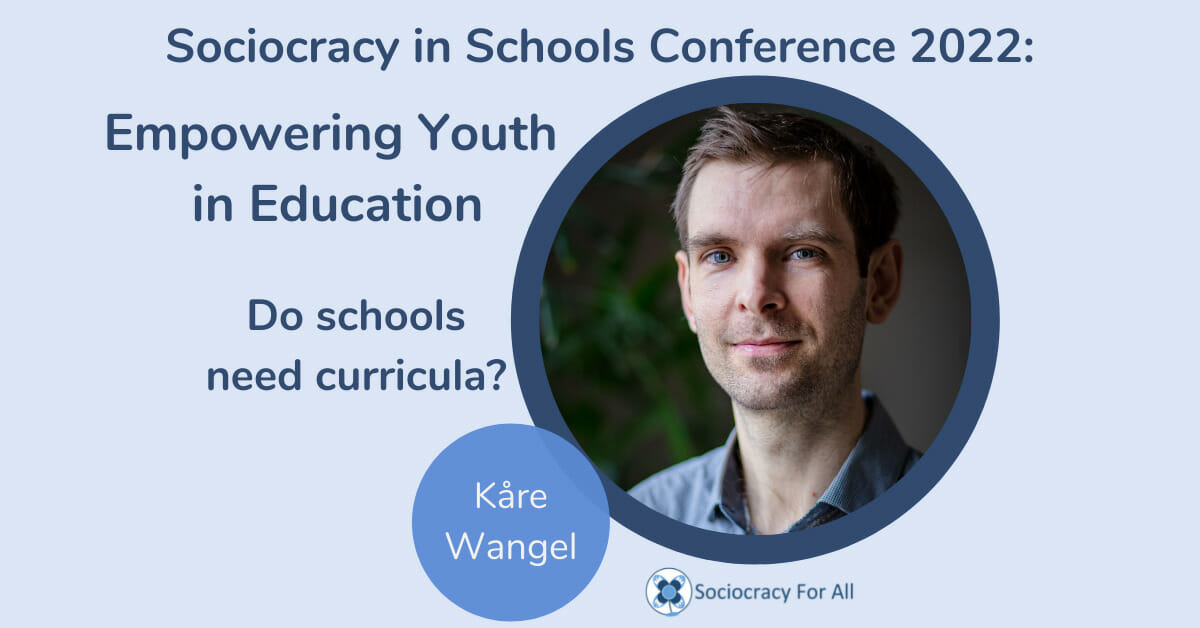
Do Schools Need Curricula? (Kåre Wangel)
Description The introduction of sociocracy into schools is in some ways a continuation of the democratic school movement, in which challenging the concept of a compulsory curriculum has always been a central facet. As soon as you propose that the pupils themselves should be a part of decision-making at their school, you realize how much…