
Language:
Consent decision making is a decision-making method that combines effectiveness and inclusivity!

Introduction
The way we make decisions
Not all decision-making methods are the same.
- Autocracy – the boss decides – is a very simple way of making a decision (at least in the short run). It is also fast. However, team members with a boss who makes autocratic decisions are very unlikely to show engagement in the organization’s success. Commitment will be less than expected, and so will innovation from the members.
- Majority vote is widely considered engaging and participatory, and we are used to considering majority vote “fair”. Voting is also fast and easy, even with many people. However, the majority vote also means that up to 49.9% of the group will be ignored. We are not gaining new information from the people who vote against the winning solution, and the level of commitment is uncertain.
- Consensus seems to be the most “fair” and inclusive way of making a decision. Only when everyone agrees can we make a decision. Commitment will be high, and so will accountability and participation. On the flipside, consensus only works well in small, homogenous groups. It hardly ever scales up to a larger group or organization.
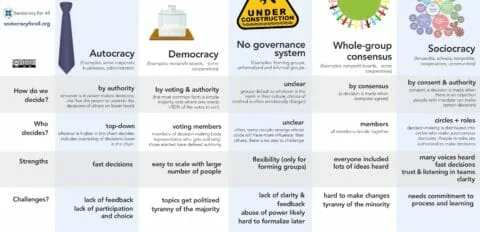
Table of Contents
Consent decision making
Between all of those, what is consent decision making? You can think of consent as a version of consensus.

But instead of asking everyone, “Do you agree?”, we ask, “Do you object?” If no one objects, there is consent.
(Note that the difference between consensus and consent continues to produce some controversy. Often, however, this compares apples and oranges because consent is a decision-making method, not a complete governance system. Read more.)
In order to understand the large impact of this little nuance between agreeing and not-objecting, it is crucial to understand the concept of “range of tolerance”.
Range of tolerance
Your personal preference will be what you would choose if you made the decision by yourself and for yourself. The ‘range of tolerance’ is everything that is not our preference but also not something we would object to. A proposal might not be our preference – but we don’t have a reason to object either.
As a picky vegetarian, I might not prefer to eat Brussel sprouts (I would not make them when cooking for myself) but I’ll eat them where they are there. I’d object to meat, however.
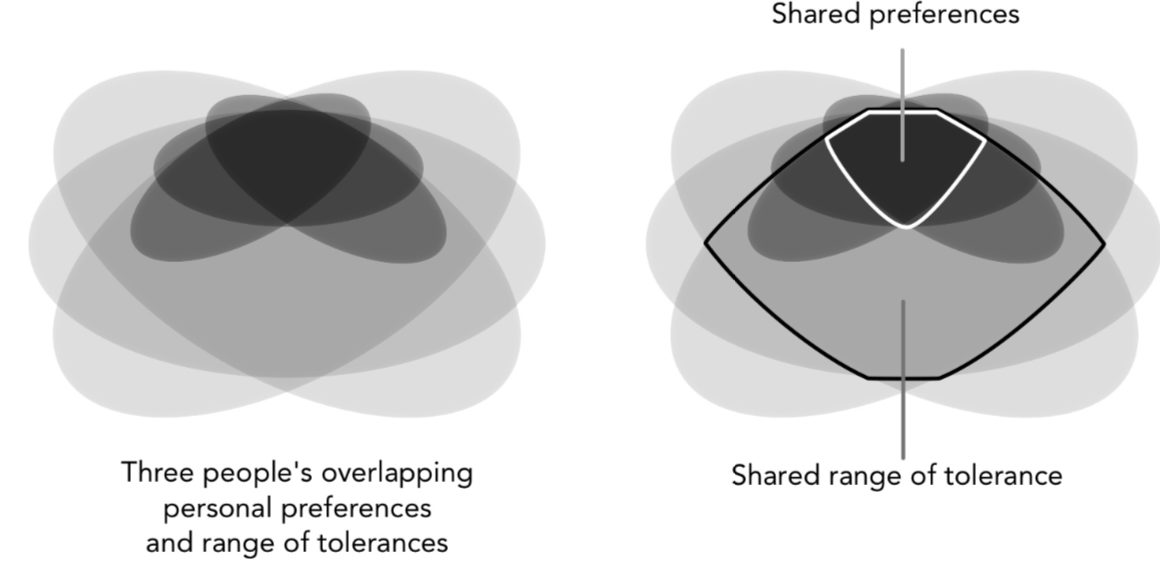
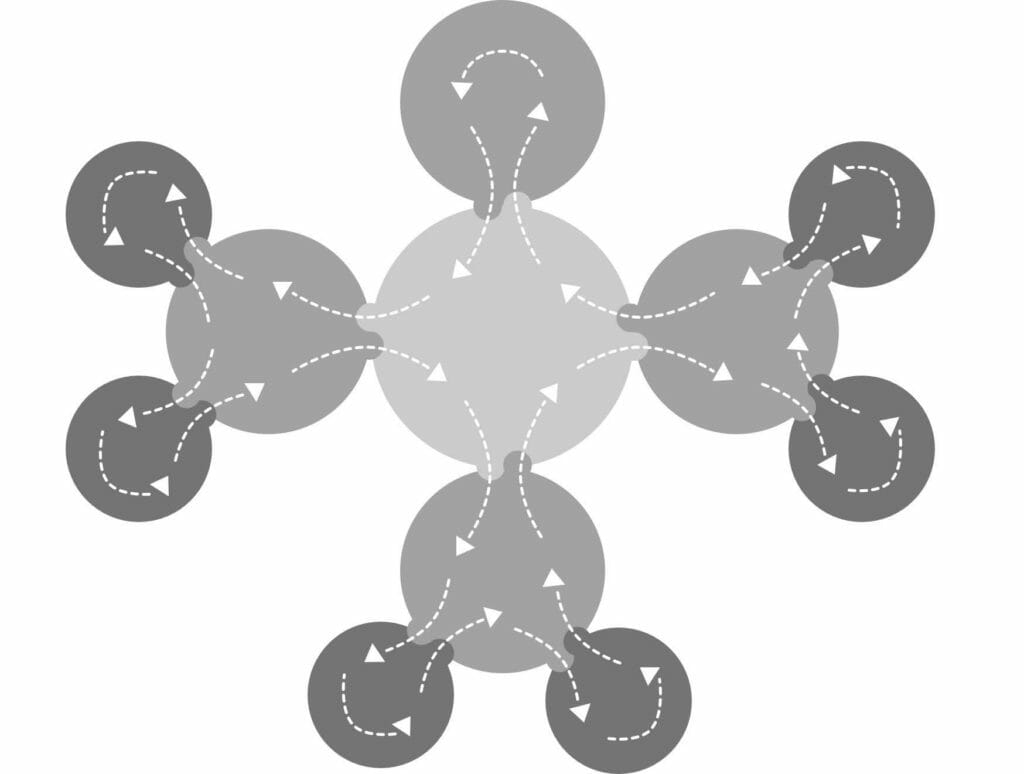
This visualization illustrates that the area of overlap between “no objection” is considerably bigger than the overlap between personal preferences. If we all had to agree, we would only make a few decisions (and that translates to simple consensus, “everyone has to agree”).
If we make decisions using consent decision making, we can make many more decisions because we have much more room to work with. The more decisions we make, the more we try out and learn – leaving the trap of endless talking and hypothesizing.
What are objections?
We need to understand the notion of an aim to understand how objections are being defined. Organizations are centered around an aim – the thing they try to do together – not individual preferences.
Aims capture what a circle (or an organization) is actually doing. Examples for aims are “baking and selling healthy bread and pastry in N. Amherst”, or “running a safe and holistic eldercare facility in Brattleboro”.
In consent decision making, objections are defined against that aim: a circle member objects to a proposal if they have reasons to assume that carrying out that proposal would harm the circle’s aim. For instance, if a bakery coop decided to buy frozen products to bake and sell, a worker-owner might object because selling ready-made products harms the bakery’s aim of “baking and selling healthy bread and pastry.”
That means that objections are now a good thing. After all, if something clearly negatively impacts the organization’s work, we have to object. That’s what an objection is. Another way of saying it is that checking for consent/objections is a way to check any decision against the backdrop of our aim. If someone notices that we’re outside of our agreements on what we do, we’d be grateful if someone points that out in time.
Objections in sociocracy are not a roadblock, however. Having options of how to move forward by incorporating the objection is a true strength of sociocracy. See how to handle objections in consent decision making.
The 3-step process of consent decision making
Now that we know what objections and consent are, let us look at the process of how we get to consent in the easiest and most time-efficient way in the consent decision-making process.
In the diagram, you can see all the steps of the consent process. Each of the three steps, presenting the proposal, working the proposal, and announcing the decision has its own purpose. Going through them step by step sounds time-consuming but really it skipping steps that will cost you and your team time and nerves!

Understanding the proposal
Presenting the proposal is important so everyone knows what the proposal is – read it out loud, or find another way of ensuring that everyone in the room knows what the proposal says – make sure you all read the same, current wording.
When everyone knows the proposal, circle members may have questions – and we take time to answer them.
Clarifying questions are often asked in rounds. Depending on group size, on how many questions you are expecting (and on how familiar or complex the proposal is), you can choose to gather questions in one round first and then let the author(s) answer the questions, or you can let the author or someone else answer questions one by one as they are asked.
A good prompt to start a clarifying questions round is to ask the circle, “What do you need to know so you understand the proposal?” because focusing on the understanding of the proposal will not sidetrack you into a discussion. To support circles even more in distinguishing between their questions for understanding and their opinions about a proposal, these are statements that will denote a clarifying question. If a group is new to this process, it is supportive for everyone to use a statement like:

- “I understand the proposal. I have no questions.”
- “I would like to have a better understanding of the proposal. Could you tell me more about the part that says ‘_____’? “
- “I would like to have a better understanding of the proposal. Could you tell me more about what led you to include the part in the proposal that says ‘__________ ‘?”
When you answer all the questions, you can ask whether more questions might have come up after hearing other people’s questions.
Quick reactions
In the quick reactions round, as the second step of the consent decision-making process, everyone gets a chance to give their opinion on a proposal. This works best if every contribution is brief – five sentences or less. No worries, if you have an objection, you will have more time to speak.

Some areas that can be touched on in quick reactions
- Whether you like the proposal or not, as quick as “I like this proposal.”, or more specific by saying why you like it. What problem is this decision going to solve in your eyes? What makes you confident?
- “I support this proposal because I see it as compatible with my personal aim to ________. I see this, particularly in the part of the proposal that says ___________. “
- “I support this proposal because I understand it to support the organization’s (aim to/value of) _______, particularly in the part of the proposal that says __________.”
- You might say that you are planning to object. Keep it brief in the quick reaction round – your time to explain your objection will come. For this round, a one-sentence statement like the following is enough: “I do not support this proposal because I don’t believe it effectively supports the organization’s (aim to/value of) ____, particularly in the part of the proposal that says __________.”
- Appreciation for the author or the process, or other individuals who supported the process.
- You can use a quick-reaction round to suggest quick amendments.
- Improvements in wording.
- Small changes that are in alignment with the proposal.
Note that amendments change the proposal
You can accept changes to the proposal before moving to consent but make sure everyone is aware of the change. Show the change visually or by re-reading the changed section. If you make too many changes in the quick reaction round, you might have to start at the beginning of the consent decision-making process (present the proposal, clarifying questions, etc.) – since you basically have a new proposal.
Your task is to avoid confusion. Confusion will turn into a loss of trust, so err on the transparent side even if that entails some redundancy.
Why are quick reactions helpful?
Hearing quick reactions is a temperature check on the group. How much support does this proposal have? Is the proposal ready to be consented to? Maybe too many people have issues with several parts of the proposal, in which case you might gather more feedback and do a rewrite before even going to objections.
On the other hand, a quick reaction round is also a wonderful way of community building. You get to hear what others think, where they are with the proposal, what it means to them, and what their concerns are, which might not rise to the level of an objection – everything that there is to say next to objections. Especially on controversial topics, it is important to ground every decision in the group and to learn more from and about each other. However, it is also important to keep statements brief and relevant since it is most effective to devote time to addressing objections. In a way, this temperature check is an investment in your shared future and coherence as a team.
Consent round
You have a proposal that everyone knows and understands, and you have heard from everyone about the proposal. It is now time to hear from everyone on whether they have objections.
Remember, “no objection” defines consent in consent decision making:
- If there is no objection, you have consent.
- If someone in the circle objects, you do not have consent.
Make sure to explicitly ask for objections. It’s not the same whether someone likes/dislikes or consents/objects to a proposal. (See this story “the day I consented to a proposal that I hated”).
If there are objections, just gather a 1-sentence statement about the nature of the objection. Make sure to finish asking everyone in the circle for their consent/objection.
After everyone has spoken, you can then address objections one by one.

Your next step
1. See it done!
This video shows a consent process without an objection:
On our facilitation page, you can see all parts of a sociocratic meeting in small videos.
2. Learn about objections
What happens if someone objects?
Learn about objections – and how we can integrate them without spending too much time or getting caught in endless right-or-wrong games.

Learn more about sociocracy overall
If you’d rather get this content by video, please visit our free 75min primer on sociocracy. Beyond consent decision making, it also covers who is even a part of the consent process and how to have meetings that work in this way.














Leave a Reply
You must be logged in to post a comment.